
The Art of Grieving in Public
What happens when grief is not private?


At the time of writing this, I am on an airplane. Somewhere between London and Los Angeles. I’ve been on the road pretty much nonstop since the fall. So much so that the flight attendant just came over to personally thank me for my loyalty.
I haven’t seen my dogs, or my own bed, in three weeks.
This whirlwind began in September, less than two months after Andrea left their body. When Ryan called to ask if I wanted to join him and tour with the film, I didn’t hesitate. “Yes,” I said. “Take me everywhere you go.”
The initial trip was to New York City, where I watched our documentary for the first time since Andrea took their final breath. It was impossible. It was exactly what I needed. To cry in public. To be witnessed by a room full of people who had just spent the last hour and forty-four minutes falling in love with the same person I lost.
Since then, the film has brought me to places I’d never been: Amsterdam, Copenhagen, Madrid. It’s taken us to Paris, San Francisco, Portland, Camden. A friend of mine calls me Eloise, the joke being that I live in a hotel.
The well-intentioned response when people get a glimpse into my proverbial calendar is: I hope you get some time alone; I hope you get some time at home; I hope you get some time to grieve.
There seems to be a notion that grief is best done behind locked doors, beneath duvets, with the blinds drawn. That it’s done in private, in pajamas. That perhaps I am not doing it right.
A few months back, I was at a coffee shop on the East Side of LA, when a journalist for the Times hit the record button between us and asked if it was weird for me to be on a press tour so soon after becoming a widow.
I glanced around at the palm trees and parking meters, the latte with the foam heart between us. “Is that what I am doing?” I asked her, in earnest. “Am I on a press tour?”
I hadn’t realized that’s what I was doing.
Because it wasn’t publicity I was after. It was proximity. Almost every night of the week, I get to see Andrea’s face—my favorite face—cast thirty feet high on a screen. I get to watch our love story unfold before my eyes, rather than solely in my mind. I get to watch them move through our home, our life, so animated with breath and blood. This doesn’t feel like a press tour, but a séance. A resurrection.


And most importantly, after the screenings, I get to talk to strangers about death until we are not strangers anymore at all.
Friends of mine who are also bereaved have spoken about how nobody knows what to say. People stick to tidy topics of conversation. The careful weather. There’s not an elephant in the room, but a ghost who others are unsure how to address. Chatter about the person gone tends to get quieter, sparser, buried beneath gentle gossip and cheaper news.
Because people don’t know how to talk about Death. There’s no course for it, no manual. In school we study algebra, chemistry. We learn how to annotate a bibliography. But not how to speak to each other. Not how to shepherd other humans through what every single one of us will inevitably experience.
We’re not taught how to hold grief, so we falsely believe it is the heaviest thing in the world we can carry.
That isn’t true. It’s only true when we have to carry it alone.
I am never carrying it alone.
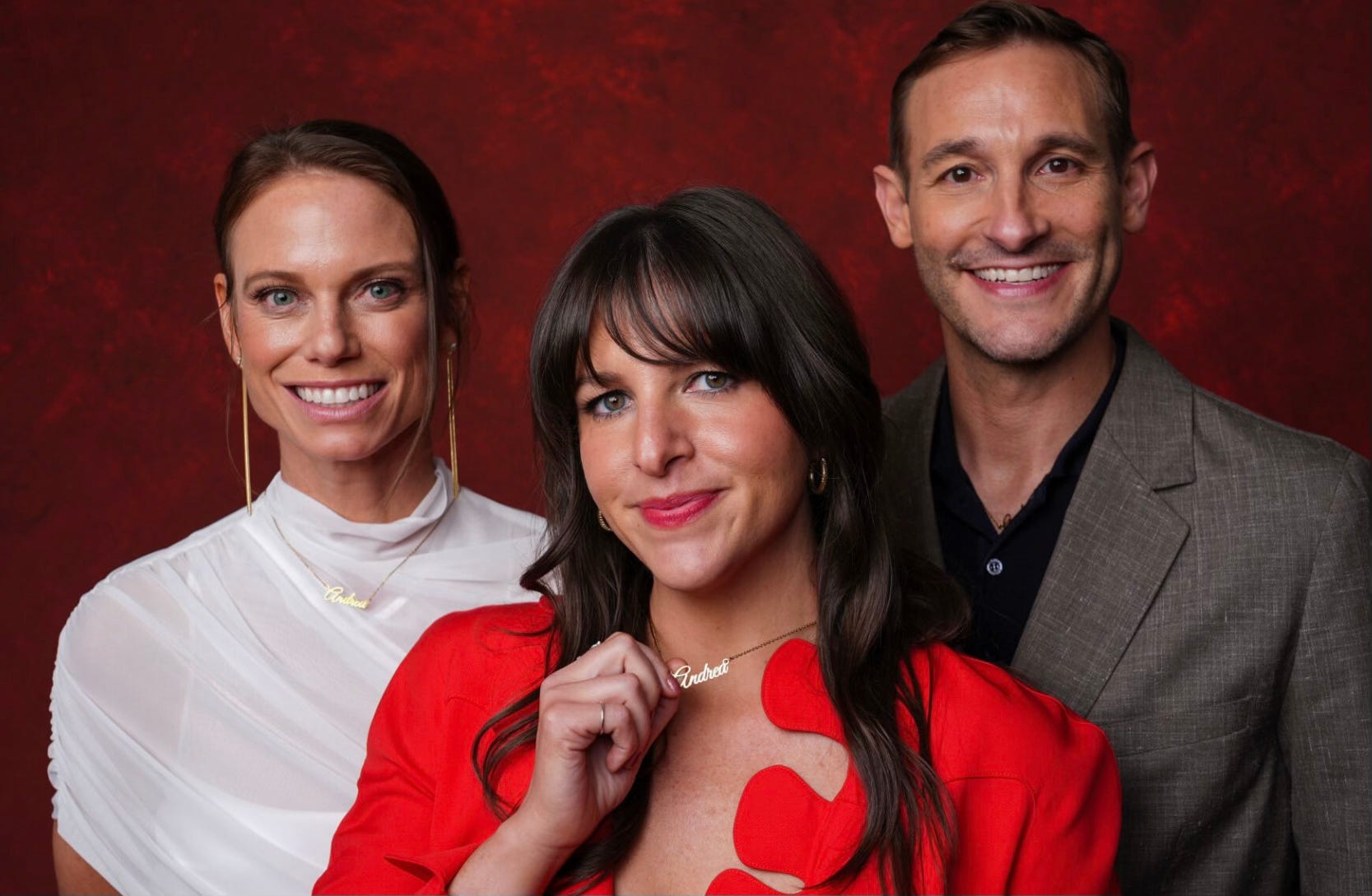
I am grieving in public. I am crying on stages. My pain is not hidden in shadows. It is spotlit. And so I am having the inverse experience of loss. Rather than people saying Andrea’s name less and less, they are saying it more and more.
Nightly, I introduce people to my spouse in a way that makes them feel so present, so alive. As if they are still on my arm, still the soft neck I whisper into as we pass through a party.
Sometimes I feel like Andrea’s earth-side delegate. I stand before new audiences carrying forward the lessons they most wanted to leave the world with. In this way, Andrea is still doing what they always did—bringing people closer to the truth of their own lives. I’m simply the voice they speak through now. A kind of translator.
Andrea once wrote, “…to die is to be reincarnated in those we love while they are still alive.”
How lucky am I?
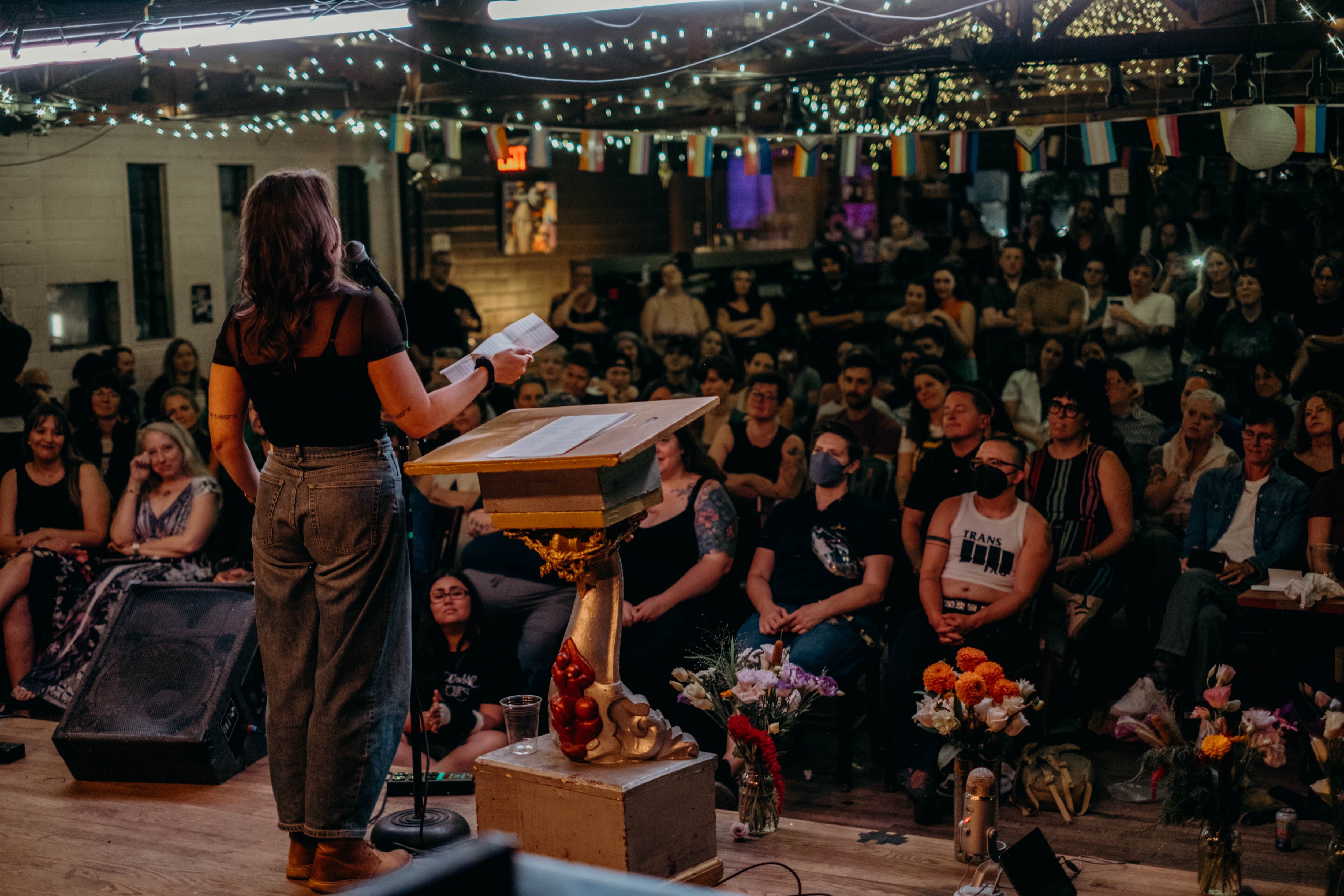
I cannot imagine how challenging it would be to be a bank teller right now. Or a dental hygienist. To clock in somewhere and leave talk of my dead at the door. To sit in a cubicle where Andrea is not allowed to enter, forbidden in the gray half-walls. How hard it would be to meet someone at a bar and somehow fit the fact that I am thirty-seven and newly widowed into a couple succinct sentences over a jukebox blaring Don’t Stop Believin’.
Everyone I meet now already knows.
Sometimes, after a screening, before we mingle with the people who have just watched the credits roll, I jokingly tell Jess and Ryan, “It’s time for me to go be Sad Santa.” Meaning there are people waiting in line to sit in my lap and tell me who in their life has died.
The truth is, I love being Sad Santa. I love the moment when someone leans in and says some version of: My mother. My brother. My wife. And suddenly the room fills with ghosts we can all see. Ghosts we can name.
Because I am carrying this so publicly, people meet me in the epicenter of truth. We enter every conversation through the door of grief. And the door of love. Which are the same door.
Andrea once wrote, “I know mortality isn’t small talk, but I wish it was.” After screenings I sometimes feel like telling them, Baby. You got your wish.
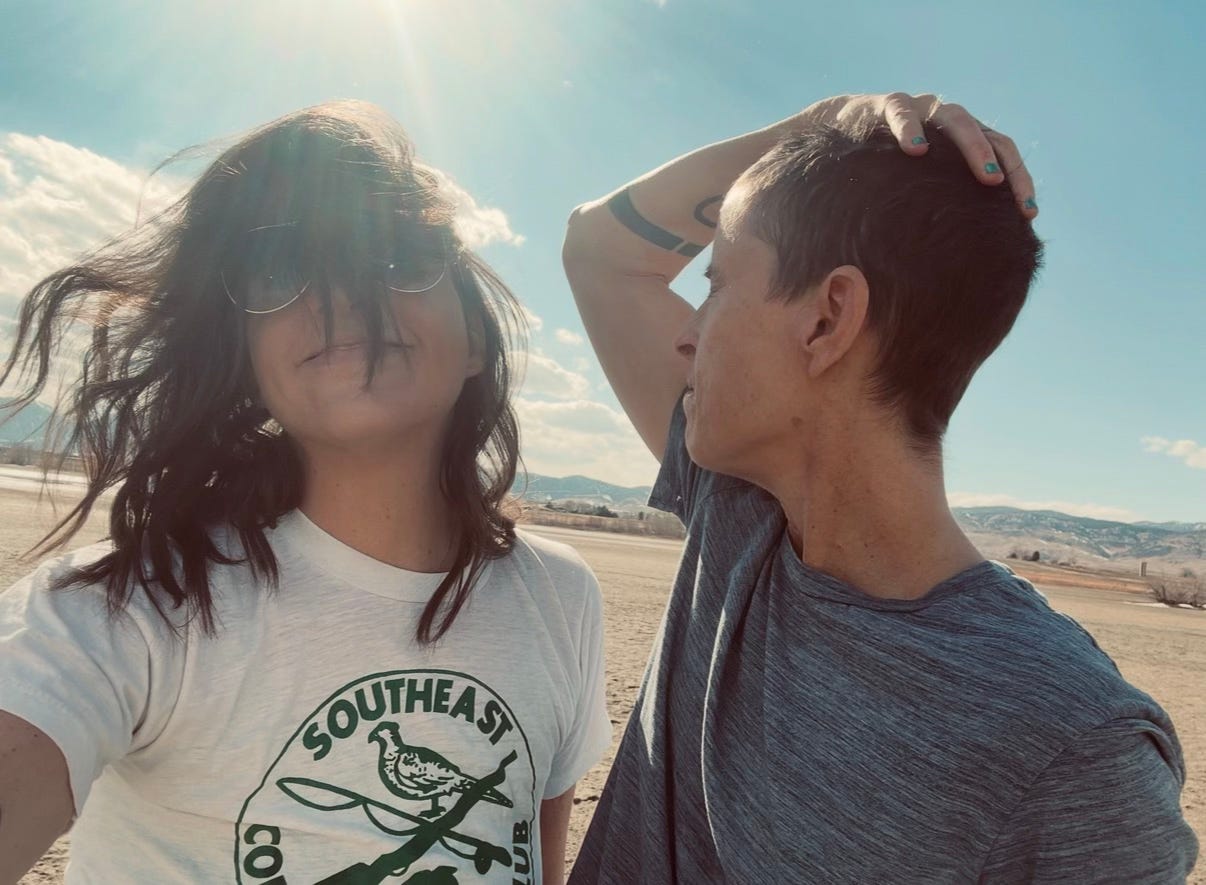
Everyone’s grieving process will have its own texture, its own timeline. I understand the allure of black-out curtains, a snooze button, DoorDash and soft pants. And I know it has its place. But I don’t believe that it is the panacea for loss like mine.
Because my grief has looked like dance floors, red carpets, pink feather dresses, six inch gold platform shoes. It’s looked like crowd-surfing, costume parties, karaoke and spraying people with champagne. Like mascara running into an unchained smile.


This is not to suggest that people go on a “press tour” with their pain. My circumstance is unusual, but the pulse of it is not. Your version might be flipping through scrapbooks, cracking open old computers to recover lost videos, scouring your phone for voicemails for the muffled breath of someone you would give anything to hear again. A refusal to stop telling their stories.
There are many ways to live inside the museum of another person. There is not a corner of my home that doesn’t hold some reflection of Andrea: their photograph, their boots, their quotes, an urn holding what could not be broken down.


And for those lucky enough to still have all of their people, you can make space for those who don’t. You can conjure them into the conversation. You can ask, “What do you miss most about them today?” or “What’s a memory that’s resurfaced?”
My friend Mika throws a massive birthday party for their wife Liza every summer, even though Liza died years ago. Why not? Why not hold a memorial a decade after a death? A funeral on a random Tuesday when you need people to remember what you can never forget?
In our culture we are always chasing the idea of closure. But I don’t want closure.
I want to open.
The way a flower opens.
The way the sky opens.

Love,
Meg [+ Andrea, forever]
PS. Recently I was given the gift of three additional scenes from “Come See Me in the Good Light.” What a gift. More time with Andrea. I share them with you now:
My mom died exactly a week before my youngest was born via a surrogate in early December. She had been my best friend for my of my life. What surprised me most in that week was how vidid the colors of there world were. It was as if everything was in technicolor. I finally pulled together a memorial service in May - after I had gotten through the beginning infant months. I then hosted monthly coffee hours in honor of my mom. Everyone at the church knew and they would come through the line and let me scoop onto their plate eggs and muffins and pie slices while asking me about my mom. It was the absolute best thing. Frankly, your experience sounds like a master class in grief and grieving. I mean just look at all that love.
I’ve found such value reading your grief processing, and often wondered what it would be like to be doing it so publicly.
I agree, this culture doesn’t know how to grieve, yet how wonderful you get to continually honor your love, and be leaning into it surrounded by like-minded people (who also adored them).
We are mostly left to invent our own rituals and try to somehow integrate this staggering pain into our lives, and it’s the loneliest I’ve ever been.
I lost my daughter Ava, my world, at 19 year old just a year ago to cancer. My son had died previously to a brain tumor, at just 2 years old. So my whole life now is about grief. As Margaret Atwood put so succinctly, “I exist in two places, here and where you are.” I am no longer completely of this earth because the people I love the most (and am biologically wired to care for) are somewhere else. My heart is consumed with them. Especially my Ava, who was my joy and partner in all things; my future and my family.
Grief is something none of us can avoid, yet when it happens to you (especially with your big loves) it’s amazing how so few lean in to witness your pain. They don’t want to be reminded it could happen to them.
Thank you for having such a brave and beautiful love, and sharing it all.